
CLASSIFYING MOVEMENTS: THE FIRST STAGE OF BUILDING A FIRST RESPONDER STRENGTH AND CONDITIONING PROGRAM
- Admin
- Jan 19
- 7 min read
"In order to identify the exercises that deserve a place in your program, you first need to know how to differentiate them."
Using strength and conditioning as a tool to improve your output and overall performance as a first responder requires specific, targeted training. The job requirements of a police officer, paramedic, fire fighter and the SES are unique compared to other occupational and sporting requirements, so the training needs to be approached with the same respect. The S&C principles behind the programs and the fitness components being trained may look similar, but the key to a successful first responder S&C program lies in the exercise selection.
The age-old question that every S&C coach has been asked time and again is ‘what’s the best exercise for [insert goal here]?’ In reality, there are several factors that go into exercise selection, and there is no single exercise that will holistically address your every need, but that’s not to say they’re all equal, either. In order to identify the exercises that deserve a place in your program, you first need to know how to differentiate them. In this article, we’ll cover three simple methods of classifying movements so that you can start making informed decisions when putting a program together.
Muscle Groups
"The agonist (prime mover) contracts to cause the joint to move, while the antagonist relaxes to allow the movement."
Most people’s first introduction to movement classification is via muscle groups. That is, which muscle is responsible for the action being performed.
Every time you move your body, that movement occurs in a joint and is facilitated by both an agonist and antagonist muscle. The agonist (prime mover) contracts to cause the joint to move, while the antagonist relaxes to allow the movement. For example, when you bend your elbow, the biceps (agonist) contracts, and the triceps (antagonist) relaxes. If the triceps stayed active, the two muscles would fight for control over the elbow joint. This is a very simple explanation of a process that occurs every time you move.
While this is a completely acceptable approach to exercise selection, it’s not the most appropriate for someone whose training goal occurs outside of the controlled environment of the gym. Once we start looking at real-world movements that don’t occur in isolation, like a police officer vaulting a fence, or a firefighter dragging a hose, it becomes tricky to identify the individual muscle groups that we need to train for improved performance in such large, dynamic, full-body movements. Instead, we need something more practical.
Movement Planes
Movement can also be categorised by the way your body moves through space, and this is a useful way to identify the type of training that may translate to dynamic occupational performance.
There are three movement planes – sagittal, transverse and frontal.
Sagittal Plane

Majority of daily human movement occurs within the sagittal plane, because it is simplest movement for our body to facilitate. It is the forward and backward, up and down movement associated with walking, running,
kicking, punching and jumping.
During sagittal plane movement, the body is divided in half, straight down the middle, and movement occurs along that midline.
Transverse Plane

Movement along the transverse plane is slightly more complex, and involves rotating, turning, or twisting. If nodding your head ‘yes’ is a good example of sagittal plane movement, then shaking your head ‘no’ is a good example of movement along the transverse plane.
During transverse plane movement, the body is divided in half horizontally, and movement occurs along this horizontal axis.
Frontal Plane

Movement along the frontal plane occurs side-to-side. Any abduction (movement of a limb away from the midline of the body) or adduction (movement of a limb towards the midline of the body) is occurring in the frontal plane, as does any sideways movement of the body.
During frontal plane movement, the body is divided into front- and back-halves via a vertical axis down the side of the body.
"As a first responder, it crucial that you incorporate all three movement planes into your workout to prevent injury and optimise occupational performance.
The human body does not exclusively exist in one movement plane at a time, and it’s easy to see how we might flow through multiple planes as they interact with one another. Something as simple getting in the car and putting on your seatbelt occurs in all three planes at different stages of the movement. As a first responder, it's crucial that you incorporate all three movement planes into your workout to prevent injury and optimise occupational movement.
Even when combined with muscle groups, movement planes can still be quite broad definitions of movement. If possible, we need to break it down one step further by classifying movement by its functional patterns.
Functional Patterns
There is no definitive list of functional patterns that is universally followed but I’ll refer to these seven: squat, hinge, lunge, upper push, upper pull, brace and rotate.
Squat
A squat movement is the lowering and lifting of the hips and torso in the coordinated flexion of the hips, knees and ankles, followed by coordinated extension of the hips, knees and ankles. The best examples of this are the many variations of the traditional squat (back, front, overhead, goblet, etc.) and the leg press.
Hinge
Hinge movements involve a forward bend at the hip with minimal knee flexion. Examples include deadlift, kettlebell swing and good morning.
Lunge
For someone with lifting experience, the lunge can be confusing to define. Unlike the squat, the functional pattern of the lunge extends beyond the well-known exercise to include anything unilateral and/or asymmetrical that loads one leg more than the other and involves a coordinated flexion and extension of the knee, hip and ankle. Examples include split squat and step up.
Upper Push (Vertical and Horizontal)
The push and pull will sometimes be split into vertical and horizontal variations, but there also exists a spectrum in between. Understand that the push category includes both vertical (overhead) and horizontal (chest press) movements. Push movements involve moving weight away from the upper body by extending the elbow and/or flexing/abducting the shoulder. Examples include bench press, push up and overhead press.
Upper Pull (Vertical and Horizontal)
As with the push category, the pull includes both vertical (pull ups) and horizontal (seated row) movements, plus everything in between. Pull movements involve bringing weight towards the body by flexing the elbow and/or extending the shoulder. Examples include barbell bent over row and lat pulldown.
Brace
The brace movement involves the stabilisation of the spine through core activation. This can be isometric against yielding or unyielding resistance, or in carrying movements. Examples include farmer’s carry and plank.
Rotate
Movements that involve the separation of the hips and torso fall under the rotate category. The hips/pelvis will rotate one way while the torso stays in place or rotates counter to the hips and vice-versa. Examples include throwing and woodchoppers.
"Daily tasks undertaken by first responders will involve majority, if not all of the seven functional movement patterns."
Daily tasks undertaken by first responders will involve majority, if not all of the seven functional movement patterns. However, while most movements can be neatly classified by one or two functional patterns, there will be exceptions. Some will require multiple functional patterns, while others cannot be defined by any of them, meaning they will often need to be considered in combination with muscle group and movement pattern for the best application.
Application
There’s two ways to apply this information – the first is proactively, and the second is reactively and you should be doing a combination of both.
To proactively apply movement classification to your program, ensure you’re ticking as many boxes as you can. The simplest way of doing this is one exercise per functional pattern covering all three movement planes.
For example:
A. Barbell Back Squat (Squat – Sagittal)
B. Dumbbell RDL (Hinge – Sagittal)
C. Lateral Lunge (Lunge – Frontal)
D. Incline DB Bench Press (Upper Push – Sagittal)
E. Single Arm DB Row (Upper Pull – Sagittal/Transverse)
F. Side Plank (Brace – Frontal)
G. Landmine Rotations (Rotate – Transverse)
"By using this proactive approach, majority of your daily occupational movements will be covered in your training, and you’ll notice an increase in performance output."
Notice that the Single Arm DB Row moves through both the sagittal and transverse plane. Unilateral (load on one side only) and contralateral (load on the opposite side to the working muscles) loading is a fantastic way to easily address the transverse plane without specifically targeting it with its own exercise.
By using this proactive approach, majority of your daily occupational movements will be covered in your training, and you’ll notice an increase in performance output. However, if there’s a specific task you want to get better at, you can reverse engineer it using the same principles.
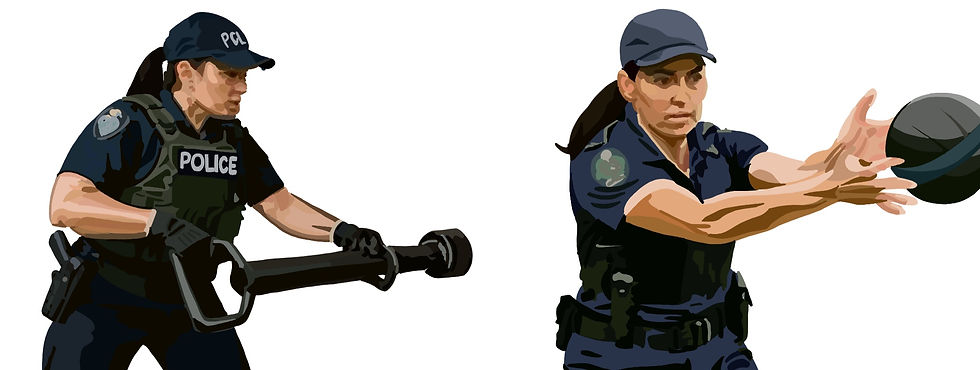
For a simple example of this concept, consider a police officer who wants to develop strength for method of entry using breaching tools. When using the ram, the required technique involves rotation in the transverse plane.
Suitable exercises to train strength for this action are also going to involve rotation in the transverse plane, such as med ball throws.
Although that explains the concept, you could likely have reached the same conclusion using common sense, so consider the more complex example of taking down and arresting a resisting offender.
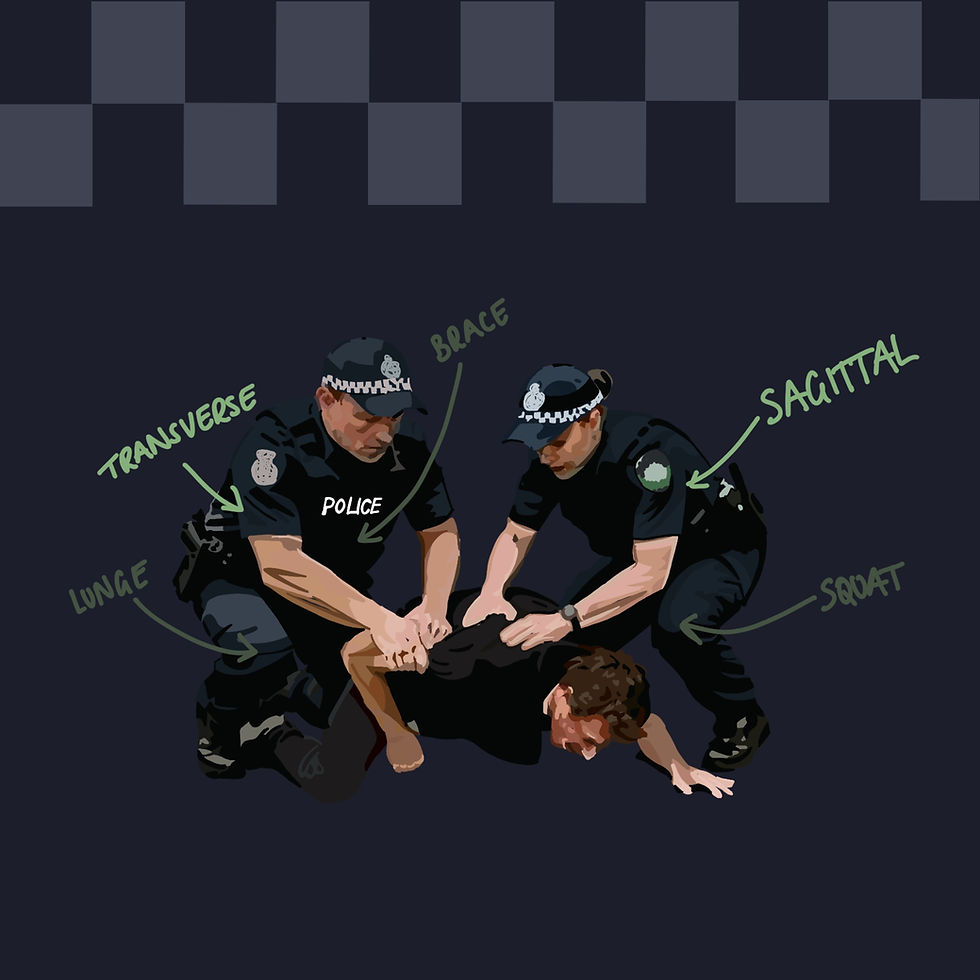
The sequence of events will look slightly different every time, but it is likely to involve some combination of the lunge, squat and brace patterns at a minimum, and will occur in the sagittal and transverse planes.

To improve in this particular occupational movement, you could address all of the functional patterns and movement planes required in just two exercises:
Front Squat: Sagittal Plane – Squat/Brace
Contralateral Lunge: Transverse Plane/Sagittal Plane – Lunge/Brace
Not only does this approach allow you to address specific occupational needs, but it ensures your exercise selection will be efficient and time friendly.
Summary
Classifying movements is the foundation of building an effective strength and conditioning program for first responders. By understanding muscle groups, movement planes, and functional patterns, you can create workouts that improve real-world performance, reduce injury risk, and enhance occupational readiness. Incorporating all three movement planes and seven functional patterns ensures balanced strength and mobility for tasks like breaching, lifting, and rapid response. Whether you apply these principles proactively or reactively, structured exercise selection will make your training more efficient and job specific.
For first responders, tactical fitness isn’t just about strength—it’s about preparing for unpredictable, high-stress situations. Start implementing these strategies today to optimise your performance and resilience in the field.

Comments